Recycling Plant for Obsolete Wind Turbine Blades
As the gradual decommissioning of early wind turbines progresses, a significant volume of wind turbine blades is entering their end-of-life phase. Typically composed of a composite structure featuring fibreglass, resin, and lightweight core materials, these blades are complex in design and substantial in size. Traditional landfill disposal not only consumes valuable land but also imposes environmental burdens. Consequently, establishing specialised recycling facilities for wind turbine blades has become an inevitable trend within the industry, offering substantial potential for resource recovery.
Crushing System: Achieving Efficient Volume Reduction and Decomposition
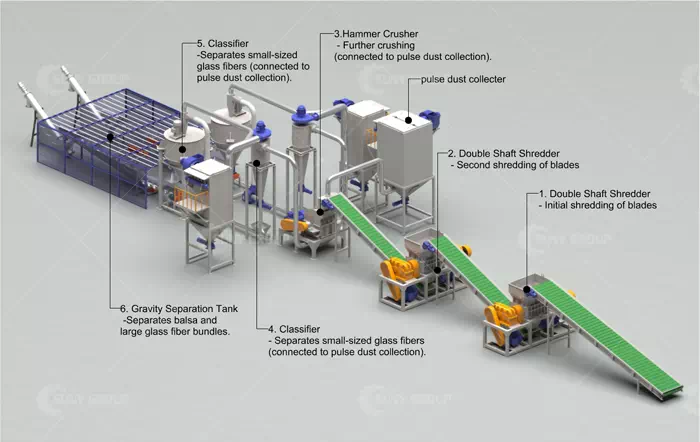
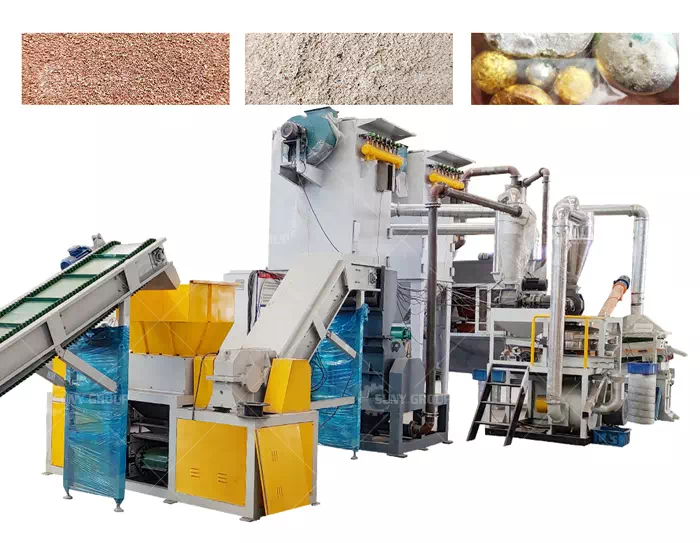
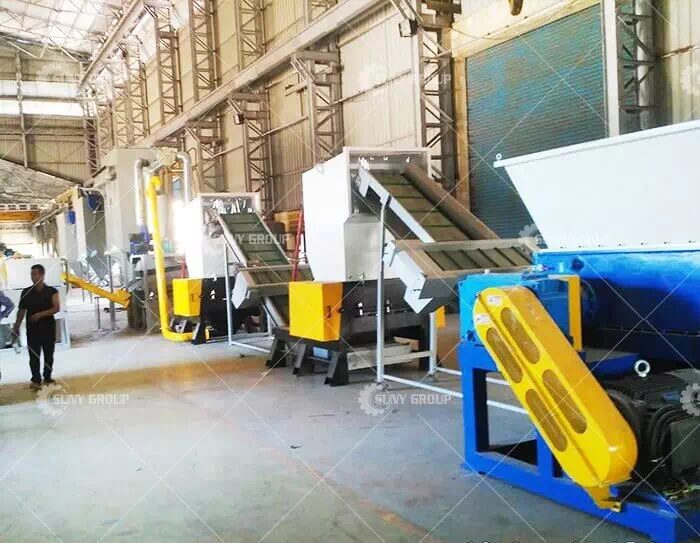
Given the large dimensions and high strength of wind turbine blades, the initial processing stage necessitates heavy-duty crushing equipment. The front end of the recycling line features a twin-shaft shredder, which employs high-torque shear forces to break entire blade sections into smaller, manageable chunks, preparing them for subsequent processing. The material then proceeds to a hammer mill, where high-speed rotating hammers further pulverise it, progressively separating the composite materials.
Recycling Plant for Obsolete Wind Turbine Blades
During the refinement stage, a knife crusher performs precise cutting, progressively separating glass fibres from the resin matrix. The multi-stage crushing structure not only enhances processing efficiency but also ensures uniform output particle size, guaranteeing stable operation for subsequent sorting processes. The entire crushing system employs a heavy-duty design, suitable for long-term continuous operation.
Sorting System: Unlocking Material Value
The core value of wind turbine blades lies in their glass fibre and resin components. The crushed composite material enters the sorting stage, where a production line equipped with grading screens and air separation systems classifies materials by size.
Gravity separation troughs further utilise density differences to effectively distinguish long glass fibres, short glass fibres, lightweight balsa wood core material, and resin mixtures. Through a combined process of multi-stage screening and gravity separation, materials are finely classified to enhance recycling purity. Separated long fibres can be reused in composite manufacturing, while short fibres and resin powder serve as fillers or reprocessed raw materials.
Automated Control and Environmental Configuration
The entire recycling line employs a centralised control system for coordinated equipment operation and parameter adjustment. The intuitive interface allows adjustment of shredding speeds and sorting parameters according to blade material variations. An integrated dust extraction system effectively controls particulate dispersion, ensuring a safe and tidy production environment.
Through this systematic shredding and sorting process, wind turbine blades transform from challenging waste into a reusable resource. As the volume of decommissioned blades continues to rise, specialised recycling facilities will emerge as pivotal drivers of the green circular economy.
Recommend products

CONTACT US:
If you have any requirement or suggestion, please fill in the form and send to us, thanks!E-mail:sunymachine@gmail.com | Whatsapp:+8613674945231